

Guides
Mockup Automation Software Price: How to Judge the Real Cost
Compare mockup automation software prices by subscriptions, credits, manual cleanup, and true cost per published product.
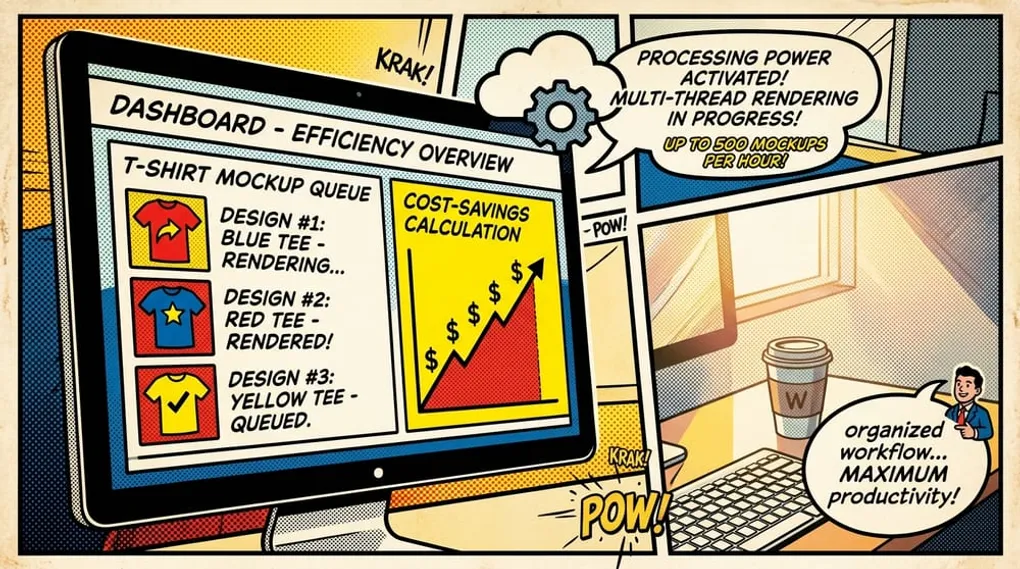
Quick answer: The best mockup automation software price is not the lowest monthly fee. It is the lowest cost per live product after you count subscription charges, top-ups, failed jobs, and the time you still spend fixing uploads, rebuilding templates, or cleaning up Shopify variants.
That is where a lot of sellers get trapped. A tool can look cheap on the pricing page and still become expensive once you are pushing real batches across Shopify or Printify every week.
The bigger your catalog gets, the faster that hidden cost shows up. Fifty designs with multiple colorways can turn a “budget” tool into a slow, manual workflow if the app stops at image generation and leaves the rest to you.
Compare the pricing models you will actually see, calculate your real cost per published product, and choose the model that fits your stage without overpaying for the wrong kind of automation.
Key takeaways
- Mockup automation software price only matters in context. The real number is your cost per published product, not your subscription alone.
- Flat monthly plans usually work best for sellers with steady weekly output and predictable batch sizes.
- Credit-based plans can be fine for seasonal stores, but they get expensive fast if failed jobs, retries, or multiple mockup variations eat credits.
- API pricing only makes sense when you already have the technical team and workflow around it.
- If a tool saves hours of Shopify cleanup, variant mapping, and retry work, a higher sticker price can still be the cheaper option.
Why cheap tools get expensive fast
Most sellers do not lose money on the render itself first. They lose money on everything around the render.
If a tool only creates mockups, you may still need to upload files manually, rebuild product settings, reorder media, map variant images, or retry broken jobs one by one. That is labor, even if it does not show up on the vendor’s pricing table.
This is the hidden “manual tax” behind a lot of mockup automation software price comparisons. The software bill looks low, but the workflow still depends on your time.
That tax usually shows up in a few places:
- Failed batches: You pay twice when a render or publish step breaks and you have to rerun it.
- Manual variant cleanup: Shopify can become the repair shop if the tool does not handle images cleanly.
- Template maintenance: Saving a few dollars on software is not a win if you spend hours rebuilding the same setup every week.
- Team training: A confusing workflow costs more as soon as you hand it to an assistant or second operator.
If your real bottleneck is not image creation but publishing speed, it helps to look at the full workflow, not just the mockup step. Our guide on how to automate Printify shows what that end-to-end path looks like when mockups, product setup, and sync all live in the same system.
The pricing models you will actually see
Most mockup tools fall into one of three pricing patterns. Some vendors blur the lines with hybrid plans, but the decision logic stays about the same.
Flat monthly subscription
This is the easiest model to budget for. You pay one monthly fee and know what your base software cost will be before you start a batch.
Best for: sellers with consistent weekly publishing, repeatable templates, and steady output.
Watch for: render caps, slow queues, hidden seat limits, or “unlimited” language that still throttles your actual workflow.
Credit-based pricing
This model works like a prepaid wallet. Every mockup, export, or high-resolution batch uses credits.
Best for: low-volume or seasonal shops that want flexibility and do not publish the same volume every month.
Watch for: credits disappearing on failed jobs, expensive top-ups, or pricing that looks fine at 20 products but painful at 200.
API or custom workflow pricing
This is the model that looks cheapest on a per-render basis and most expensive in practice if you are not ready for it.
Best for: teams with developers, custom storefront logic, or a real need to plug mockup generation into a broader internal system.
Watch for: build cost, maintenance time, retry logic, and the fact that an API still does not solve your workflow unless someone builds the rest of the workflow around it.
How to calculate your real cost per live product
Do not compare tools by monthly fee alone. Compare them with this formula:
(monthly software spend + monthly labor cost + add-ons or top-ups) / successfully published products
The key phrase is successfully published products. A cheap render is not cheap if it never makes it cleanly to the product page.
Here is a simple example:
- Tool A:
$39plan,$40in extra credits, and4hours of cleanup at$25an hour =$179 - Tool B:
$99plan, no top-ups, and1hour of cleanup at$25an hour =$124 - If both workflows publish 250 products: Tool A costs about
$0.72per live product, while Tool B costs about$0.50
That is why sticker price can be misleading. The more work the tool removes after the render, the better the price usually gets.
If you are already publishing in larger runs, the pattern becomes even clearer. Our walkthrough on uploading 50 designs to Printify is a good benchmark for the kind of batch size where labor costs start outgrowing subscription savings.
Which model fits your stage
The right mockup automation software price model depends less on your budget and more on how you work.
- Seasonal or low-volume seller: Credit-based pricing can work if you only launch in bursts and you do not mind variable monthly costs.
- Steady weekly publisher: A flat monthly plan is usually easier to control because your batch rhythm is predictable.
- High-volume Shopify operator: Look for the workflow with the lowest cleanup time, not the lowest render price.
- Technical team with custom needs: API pricing can make sense, but only if you already own the engineering overhead.
There is also a practical team question here. If you want someone else to help with production, clear status tracking and clean retries matter a lot more than saving a small amount on the plan price.
When a higher sticker price is actually cheaper
Once you move past one-off mockups, the better buy is usually the tool that removes the most repeat work.
That is why workflow fit matters more than feature count. If your design files are organized, your mockups are generated in batches, your products are created from templates, and your Shopify images sync cleanly, your real cost drops even if the monthly plan is not the cheapest on paper.
That is the case Mockup Maestro is built for. You can organize artwork in Smart Design Manager, create batches with Bulk Mockup Generator, build listings with Bulk Product Creator, and finish the last Shopify step with Shopify Mockup Sync.
If you are still deciding whether the bottleneck is headcount or workflow design, read Scale Shopify Listings from 10 to 1,000 Without VAs. It breaks down where the real labor shows up once your catalog starts growing.
Ready to lower your real cost per product?
If your current tool still leaves you doing manual cleanup after every batch, Mockup Maestro helps you move from design file to live product with less overhead.
Frequently asked questions
What is the best mockup automation software price model for beginners?
It depends on volume. Credit-based pricing can be fine if you publish small batches, but a clear flat plan is often easier once you start launching new products every week.
Should I compare price per render or price per product?
Compare price per published product. Price per render ignores failed jobs, manual retries, Shopify cleanup, and all the other work that still has to happen after the image is generated.
When does API pricing make sense?
API pricing makes sense when you already have a developer or technical team and a real reason to build a custom workflow. It is usually the wrong first move for a small POD shop that mainly needs faster publishing.
Is the cheapest tool good enough for Shopify POD?
Sometimes, yes, if your catalog is small and you do not publish often. Once you are managing repeat batches, multiple product colors, or weekly drops, the cheaper tool often becomes more expensive because of the cleanup it leaves behind.
Next steps
Related workflow pages
Turn this guide into a working production path inside Mockup Maestro.
Bulk mockup generator for Printify
Create consistent lifestyle mockups across large batches without manual downloads.
Custom Printify mockup generator
Build reusable mockup scenes and batch-render branded product visuals.
Mockup catalog
Choose product-specific mockup workflows for apparel, mugs, stickers, and more.
Sync Printify mockups to Shopify
Map the right mockup to each Shopify variant and reduce storefront cleanup.